

Construction’s Productivity Problem: 75 Years of Data That Should Bother You

Construction labor productivity in the US is slightly below where it was in 1950. Every other major industry has tripled. A new Goldman Sachs analysis published by a16z puts data behind what most people in the sector already feel – construction stopped adopting new technology around 1968, and the bill has been compounding ever since. Here’s what the numbers actually show, and what they mean for contractors, founders, and investors paying attention.
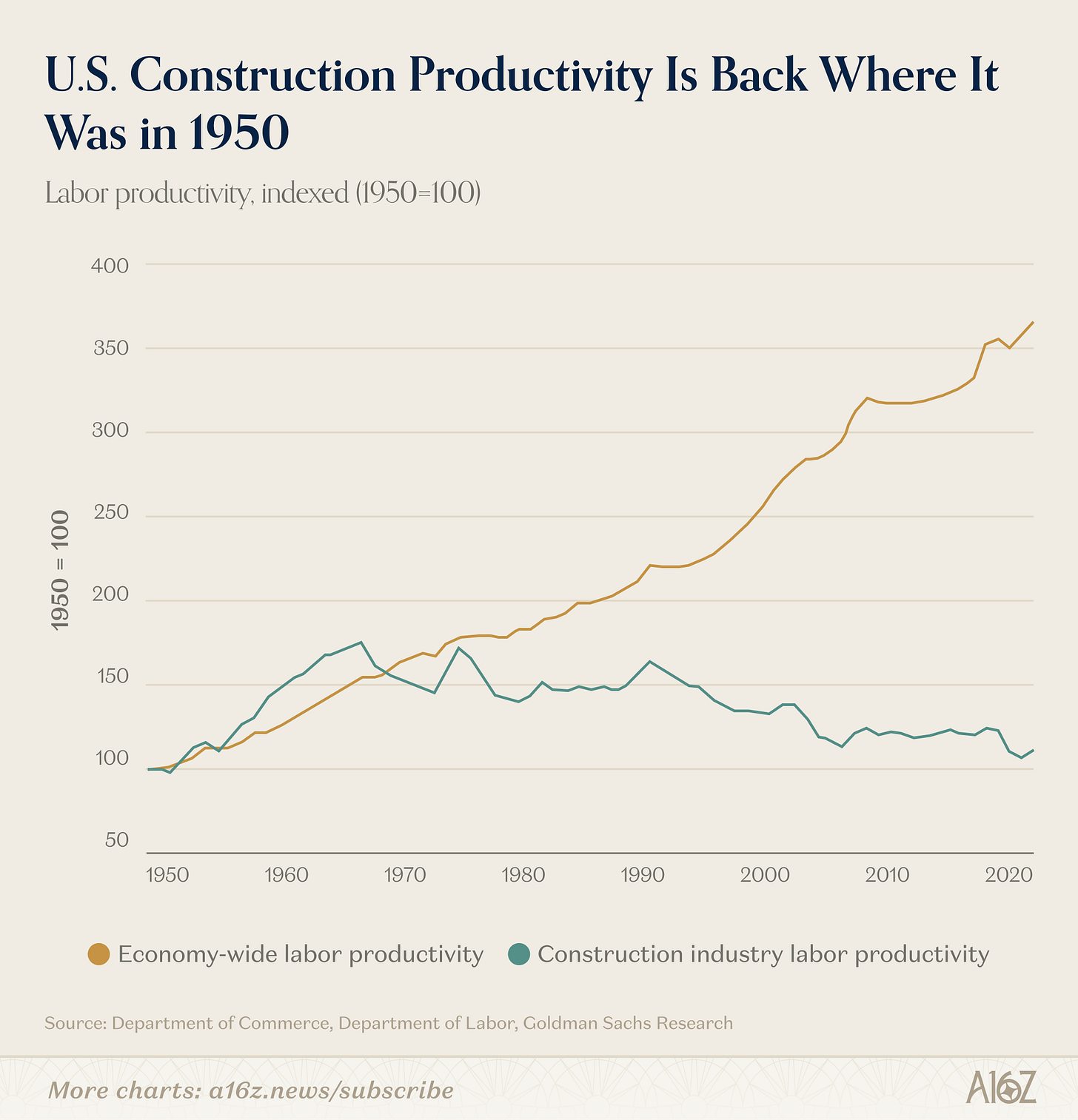
A chart dropped this week that most construction execs will find either vindicating or deeply uncomfortable, depending on how long they’ve been fighting this particular battle. It comes from Goldman Sachs Research, surfaced in an a16z newsletter from April 10, 2026, and it tracks US labor productivity across the entire economy from 1950 to today.
The economy-wide line roughly triples. Construction’s line goes sideways. Technically, it ends up slightly below where it started 75 years ago. That’s not a rounding error or a methodology quirk. That’s a genuine, decades-long failure to get more output per worker-hour in a $2 trillion industry that builds the physical infrastructure everyone else depends on.
For anyone who has spent time on a job site or inside a contractor’s P&L, the chart won’t feel surprising. What’s useful is the data behind it – specifically, what Goldman’s analysis says about why productivity stalled, and how regulation, technology adoption, and industry structure all contributed. There’s also a meaningful venture angle worth tracking, as the same a16z piece frames construction as one of the largest remaining opportunities for robotics, prefabrication, and AI-driven tools to actually close the gap.
The Productivity Gap: What the Numbers Actually Show
75 years of divergence, in one chart
The Goldman Sachs data is striking precisely because it covers such a long time horizon. Since 1950, US economy-wide labor productivity has roughly tripled – a compounding of incremental gains across manufacturing, services, agriculture, finance, and tech. Construction’s trajectory over the same period looks, generously, flat. Less generously, it’s fractionally negative.
To put that in practical terms: a construction worker today produces roughly the same economic output per hour as a construction worker in the early 1950s. A factory worker, a finance professional, a healthcare administrator – they’ve all seen their industries transform through mechanization, computing, and process redesign. Construction, as an industry, largely has not. The machines changed in incremental ways; the process of organizing and delivering projects has stayed structurally similar for most of that span.
This matters beyond the abstract. Productivity stagnation is the underlying driver of rising construction costs, housing unaffordability, and the persistent gap between what infrastructure projects cost to deliver versus what they could cost if the industry performed like its peers. Every percentage point of productivity left on the table is real money – in overtime, in rework, in project overruns that erode margins already sitting at 2-3%.
Why Technology Adoption Stalled After 1968
The machines arrived. Then they stopped arriving.
Goldman’s analysis makes a specific and fairly telling observation about technology adoption in construction. Between 1948 and 1968, the share of industrial machines in total construction costs tripled – rising from around 4% to 12%. That’s a period of genuine mechanization: bulldozers, concrete mixers, cranes, and related heavy equipment transformed what was possible on a job site. Productivity improved accordingly.
Then the machine share flatlined. For the next 50-plus years, the equipment used on most job sites has been largely the same category of tools, with incremental refinements but no structural change in the ratio of machine input to labor input. The bulldozer got better GPS. The concrete mixer got more consistent batch control. But the fundamental composition of how construction work gets done, lots of people coordinating physical tasks with limited automation, didn’t shift.
Goldman contrasts this with pharma and professional services, both of which absorbed spillover benefits from computing and communications technology. Construction largely missed those waves. Software arrived in the form of CAD and later BIM, but those tools affected design workflow far more than they affected the physical act of building. The job site, in most firms, stayed labor-intensive and coordination-heavy in ways that didn’t improve with the broader digital revolution.

- 1948-1968. Machine share of construction costs rises from 4% to 12% – the industry’s most productive technology era.
- 1968 onwards. Machine share flatlines. The equipment categories remain the same for the next 50+ years, with no meaningful structural change in labor-to-machine ratios.
- Computing era. Unlike pharma and professional services, construction doesn’t absorb major productivity spillovers from the digital revolution. BIM helps design. It doesn’t change the job site.
The Regulation Factor
Land use rules and the 0.7 percentage point drag
Technology adoption isn’t the only variable Goldman’s research identifies. Regulation, specifically the tightening of US land use rules since the 1960s, gets quantified as a meaningful drag on construction productivity growth. Their estimate: increased land use regulation has reduced annual construction productivity growth by 0.7 percentage points.
That’s a specific number worth sitting with. Over decades, 0.7 percentage points per year compounds into a very large gap. The regulatory environment shapes what gets built, where, and at what density. More restrictive zoning tends to push construction toward lower-density, more complex, and more customized projects, which are harder to systematize and harder to automate. A high-density residential tower with repeatable floor plates is a fundamentally different productivity profile than a scattered portfolio of custom single-family homes built across dispersed sites under varied local codes.
Goldman is clear that the full picture is still debated. Brian Potter’s research through Construction Physics – cited in the a16z piece – points to industry fragmentation, the historical availability of cheap labor, lower-density building patterns, and even measurement challenges as additional contributing factors. The causes aren’t cleanly separable. But taken together, they describe an industry that faced structural headwinds in every direction: it wasn’t incentivized to automate, wasn’t rewarded for building densely, and wasn’t forced to upgrade its tools the way other industries were.
“Construction is a $2 trillion industry that’s been waiting 60 years for its technology upgrade.”a16z newsletter, April 10, 2026, citing Goldman Sachs Research
Get the construction briefing that connects the dots
Data, deals, and sharp takes on ConTech and the built world – direct to your inbox, weekly.
Join 2500+ ReadersThe Opportunity Side: Where the Investment Thesis Lives
Robots, prefab, and AI as the long-awaited upgrade cycle
The a16z framing of this data is explicit: construction’s productivity stagnation is “a major contributor to the housing affordability crisis – and one of the largest opportunities for robotics, prefabrication, and AI-driven construction tech to make a dent.” That’s not a casual observation from a generalist newsletter. A16z has meaningful exposure to physical technology companies, and the way they frame construction sits alongside their broader thesis on the shift from bits to atoms – a cycle they see as fundamentally different from cloud and mobile because it requires factories, fabrication, and real-world deployment.

For ConTech founders and investors, the productivity chart is almost a mandate. If construction productivity has been flat for 75 years and the gap versus the rest of the economy is now enormous, the return available from closing even a fraction of that gap is proportionally large. That’s the underlying investment logic for companies working on robotic bricklaying, off-site manufacturing, AI-driven scheduling, and autonomous site inspection. The market failure has been running for decades. The addressable improvement is genuine.
For contractors, the read is different but equally concrete. The firms that figure out how to increase output per worker-hour – whether through better process design, selective automation, or smarter use of data – will have a structural cost advantage over competitors still operating at 1950s productivity levels. In an environment of tight margins and persistent labor shortages, that gap won’t stay theoretical for long. We’ve covered the signals pointing in this direction before, from how ConTech investors are separating real solutions from the noise to the broader question of what ConTech actually covers across the full project lifecycle.

Comparing the Drivers of Construction’s Productivity Problem
A quick-reference breakdown of the key factors
| Factor | What happened | Productivity impact | Reversible? | Technology lever |
|---|---|---|---|---|
| Technology adoption freeze | Machine share of costs flatlined after 1968 | No gains from automation post-1968 | Yes – actively reversing now | Robotics, prefabrication, autonomous equipment |
| Land use regulation | Tightened from 1960s onwards | -0.7 percentage points per year (Goldman estimate) | Partial – policy-dependent | Modular and off-site construction |
| Industry fragmentation | Highly fragmented supply chain and subcontractor model | Limits standardization and scale economies | Partial – consolidation is slow | Platform software, integrated delivery models |
| Cheap labor availability | Historically dampened incentive to automate | Removed pressure to invest in productivity tools | Reversing – labor shortages accelerating | Automation, robotics-as-a-service |
| Low-density building patterns | Harder to standardize and systematize | Limits repeatability and economies of scale | Partial – density increasing in urban markets | Volumetric modular, mass timber, design for manufacture |
| Computing spillover missed | Construction didn’t benefit from digital revolution at the site level | Lost 40+ years of compounding digital gains | Yes – AI and site tech now targeting this directly | AI scheduling, computer vision, digital twins |
Frequently Asked Questions
Goldman Sachs Research, as cited in the a16z newsletter of April 10, 2026, identifies several overlapping causes. The industry mechanized rapidly between 1948 and 1968 – machine share of construction costs tripled from 4% to 12% in that window – then stopped. The machines used on most job sites today (bulldozers, cranes, concrete mixers) have been available since the 1950s. Unlike pharma or professional services, construction didn’t absorb major productivity gains from computing or communications technology. Add in tightened land use regulation, industry fragmentation, and the historical availability of cheap labor, and you have a set of structural conditions that together suppressed the investment case for productivity-improving technology for decades. (Source: a16z, April 2026)
Goldman Sachs estimates that increased US land use regulation since the 1960s has reduced annual construction productivity growth by 0.7 percentage points. That’s a compounding drag – across 60-plus years, it adds up to a very large cumulative gap. Stricter zoning tends to push construction toward lower-density, more customized work that’s harder to systematize, automate, or apply factory-style repeatability to. It’s worth noting that this is one factor among several, and the full picture, as noted by researcher Brian Potter at Construction Physics, involves fragmentation, labor availability, and measurement challenges too. (Source: a16z, April 2026)
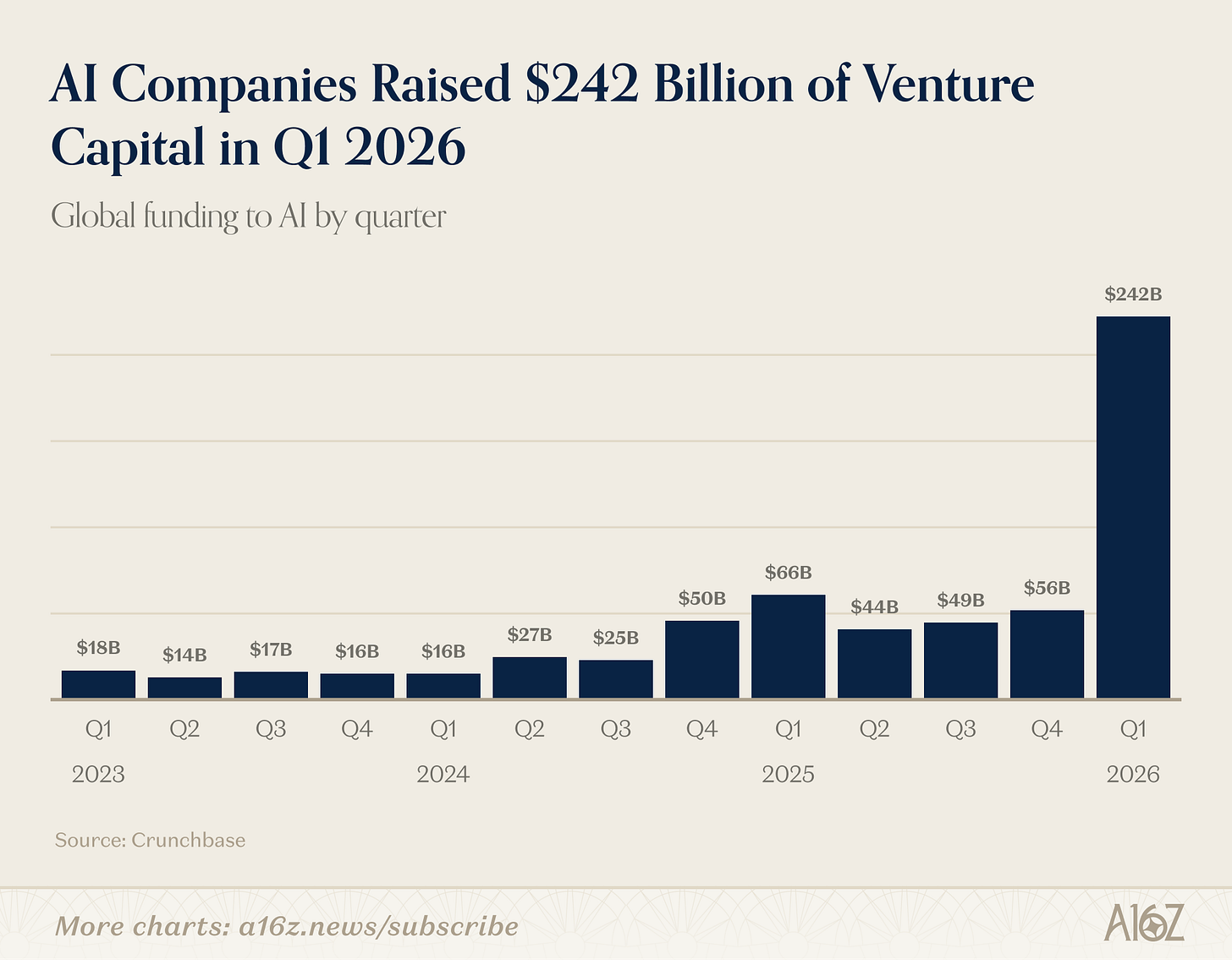
The a16z framing is direct: a $2 trillion industry that’s been flat on productivity for 60 years represents one of the largest available opportunities for robotics, prefabrication, and AI-driven construction tools. If even a fraction of that gap gets closed, the economic value created is enormous. The broader venture context is also relevant here – Q1 2026 was the largest quarter for global venture investment ever recorded, with $300 billion deployed according to Crunchbase data. Roughly 80% of that went to AI companies. The subset targeting physical industries, including construction, is building on an infrastructure thesis that A16z describes as fundamentally different from prior tech cycles because it requires factories, fabrication facilities, and physical deployment rather than just software. (Source: a16z, April 2026)
Not exactly. The Goldman data covers US construction labor productivity broadly, and the debate around causes points to meaningful variation. Lower-density residential construction is particularly hard to mechanize given its dispersed, customized nature. High-density urban construction, large infrastructure projects, and industrial builds have more potential for process standardization and automation. The fragmented subcontractor model common across commercial construction also creates coordination overhead that drags on productivity in ways that a more integrated delivery structure might not. So the industry average is dragged down by segments with structural constraints, while others could theoretically close the gap faster if the right tools and business models scale. (Source: a16z, April 2026)
Directly. When productivity is flat for 75 years, building costs don’t fall in real terms – they tend to rise with input costs (materials, labor rates, compliance) without any offsetting efficiency gain. That means every new housing unit is more expensive than it needs to be relative to what it would cost if the industry produced output more efficiently. The Goldman analysis frames construction’s productivity stagnation as a “major contributor” to housing unaffordability, and it’s hard to argue otherwise. Closing the productivity gap, through any combination of automation, off-site fabrication, better software, or regulatory reform, is one of the few levers available to structurally reduce the cost of delivering new homes. (Source: a16z, April 2026)
The a16z piece names robotics, prefabrication, and AI-driven construction tech as the primary candidates. Each targets a different part of the problem. Robotics attacks the labor-intensity of on-site trades directly. Prefabrication and modular construction moves work into controlled factory environments where repeatability, quality control, and machine use are easier to optimize. AI-driven tools, from scheduling to computer vision to cost estimation, target the coordination overhead and information management failures that drain productivity without appearing in any machine share metric. The most durable productivity gains are likely to come from combinations of all three, particularly where they’re integrated into delivery models that change how projects are actually organized, not just which tools get used. (Source: Bricks & Bytes)
The broader venture numbers are relevant context even if they’re not construction-specific. According to Crunchbase data reported by a16z, Q1 2026 saw $300 billion in global venture investment – up more than 150% both quarter-over-quarter and year-over-year, making it the largest quarter on record. Around 80% of that went to AI companies, up from 55% a year prior. The billion-dollar cohort included companies building chips, robots, self-driving systems, and defense platforms. A16z frames this as the “bits to atoms” rotation – AI infrastructure that requires physical manufacturing rather than pure software. Construction-adjacent companies (robotics, autonomous equipment, prefab, site AI) sit squarely in that frame, which means the macro funding environment is arguably more favorable for serious ConTech companies now than at any prior point. Early-stage funding was also up 41% year-over-year and seed was up 31% in dollar terms, so it’s not just mega-rounds pulling the numbers. (Source: a16z, April 2026)
a16z: Charts of the Week – Venture’s $300B Quarter (April 10, 2026)
Construction Physics by Brian Potter
Bricks & Bytes: Separating Signal from Noise in the ConTech Investment Landscape
Bricks & Bytes: What Is Construction Technology (ConTech)?
Related Articles
Separating Signal from Noise in the ConTech Investment Landscape
What Is Construction Technology (ConTech)?