
Humanity's relationship with tools follows a single, persistent logic: turn recurring labor costs into one-off capital investments. A spear made two hunters more effective than four without one. A power drill made one worker faster than three with manual tools. An autonomous haul truck removes the need for a human operator entirely in conditions where nobody wants to work anyway, remote mines in scorching heat, with fly-in fly-out commutes.
That pattern has repeated for thousands of years. And the current chapter, robots in physical industries, is just the latest iteration of the same idea. What makes it interesting right now, particularly in construction, is that the technology is finally catching up to the ambition. But adoption? That's a different story entirely.
From Sharp Stones to Power Drills
Tools accelerate productivity. That much is obvious. What's less obvious is the speed at which that acceleration happens, and how much it depends on whether the work being automated is something people actually want to do. Dull, dirty, and dangerous jobs attract fewer workers, which makes the remaining workers expensive, which makes the ROI case for automation much cleaner.
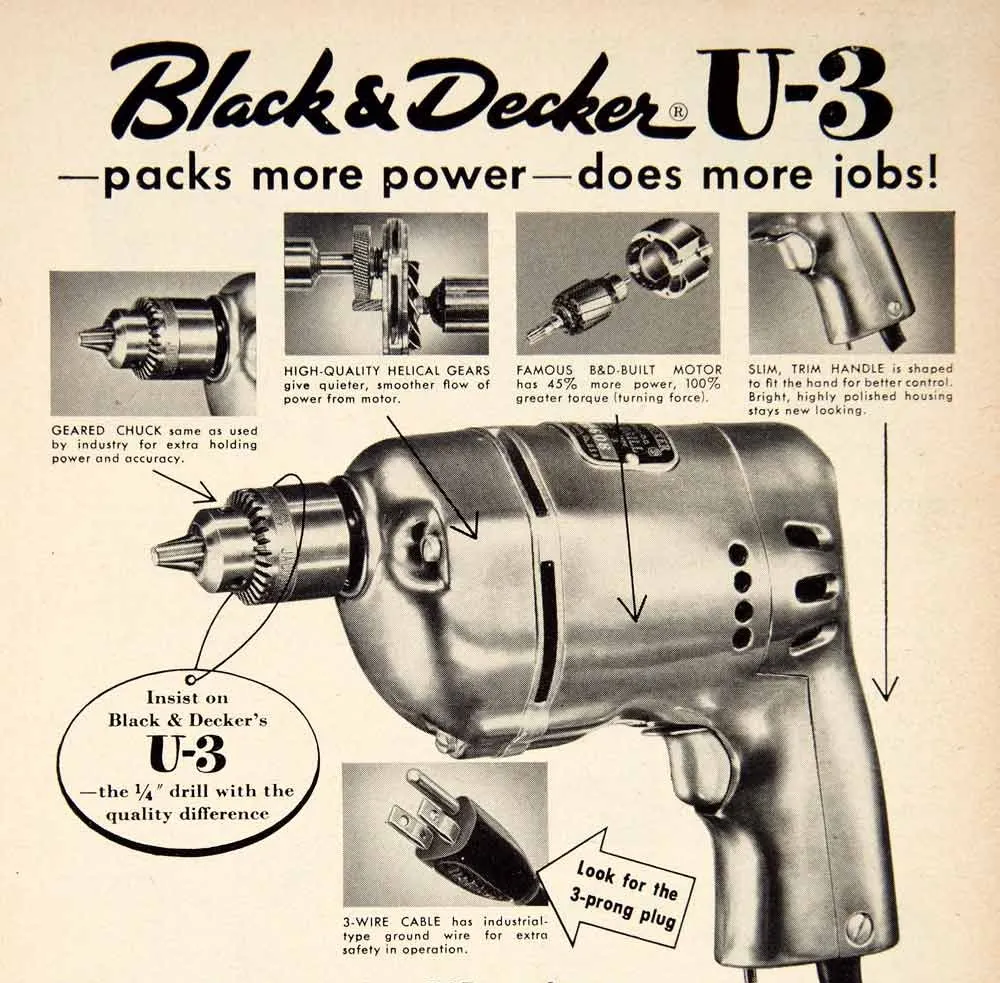
An old Black & Decker ad for one of their early electric utility drills. The company patented the first portable drill in 1917 and the first electric screwdriver in 1923. The labor productivity those two inventions unlocked is hard to overstate.
Black & Decker is worth pausing on. Founded in 1910, the company (now Stanley Black & Decker after the 2010 merger) patented the first portable drill in 1917 and the first electric screwdriver six years later. Those two inventions alone reshaped how physical work gets done, on job sites and in living rooms wrestling with flat-pack furniture. Simple tools, massive compounding effect.
The leap from power tools to robots is conceptually straightforward: pair a tool with a computer, give the computer the ability to take in instructions and sensor data, and let it execute physical actions through actuators. That's a robot. It's just another tool in the long arc of humanity converting OpEx into CapEx.
Computers enable two things that physical tools can't: perfect replication (digital information copies infinitely without loss) and tireless automation (algorithms execute precise operations billions of times without fatigue). Combine those capabilities with sensors and actuators and you get something powerful enough to augment, and in some cases replace, human labor entirely.
How Robots Conquered Other Industries First
Before we get to construction, it's worth understanding how robotics adoption played out in other physical industries. The pattern is instructive.
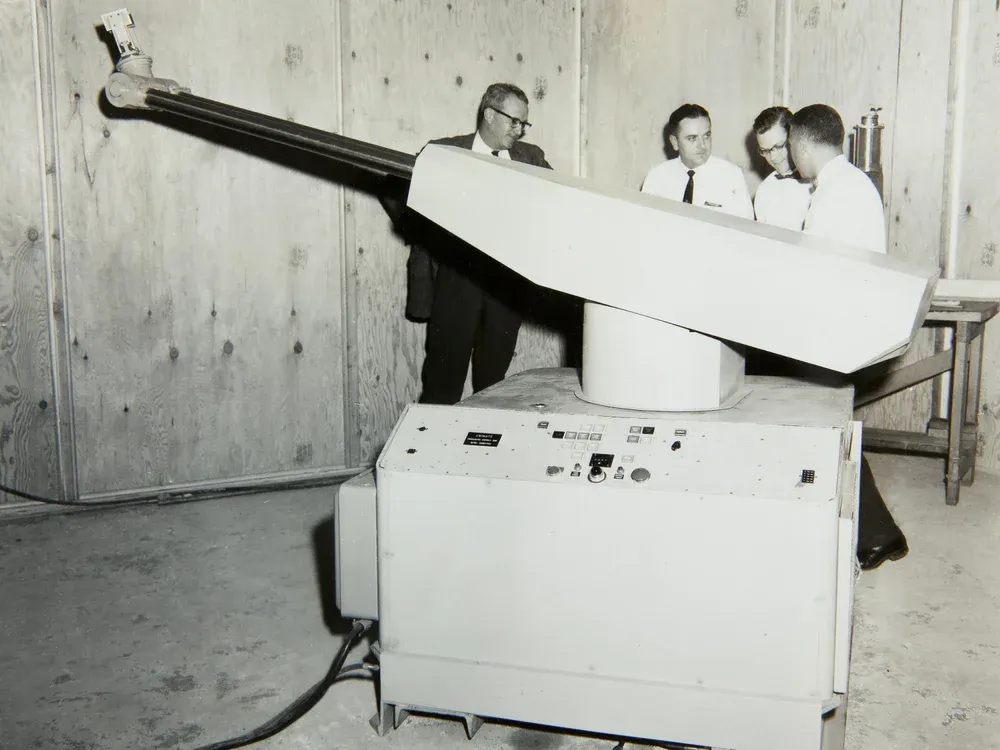
One of the earliest versions of Unimate, the robot that started it all. Deployed at General Motors in the 1960s for die casting and spot welding, it set the template for industrial automation that every subsequent wave has built on.
The common thread across all three waves: controlled environments, standardized inputs, and repeatable tasks. Factories, warehouses, and dairy barns share a crucial feature with each other that they don't share with construction sites. Predictability.
Why Construction Should Be Perfect for Robots (But Isn't, Yet)
On paper, the case for robotics in construction is overwhelming.
Construction sits on a throne with mining as the mother of dull, dirty, and dangerous work. Globally, the industry carries brutal rates of injuries and fatalities from falls, struck-by incidents, and repetitive stress. The safety case alone should justify aggressive automation. Add in throughput (robots don't take breaks, don't unionize, and don't call in sick) and consistency (robots verify the quality of their own work through built-in QA/QC), and the logic seems airtight.
Yet the deployment numbers tell a different story. Very few construction robots performing physical tasks have crossed the 100-deployment threshold. Relative to a $15 trillion global industry, that's essentially zero.
What has actually worked
Two categories of construction robotics have gained meaningful traction, and they share something telling in common.
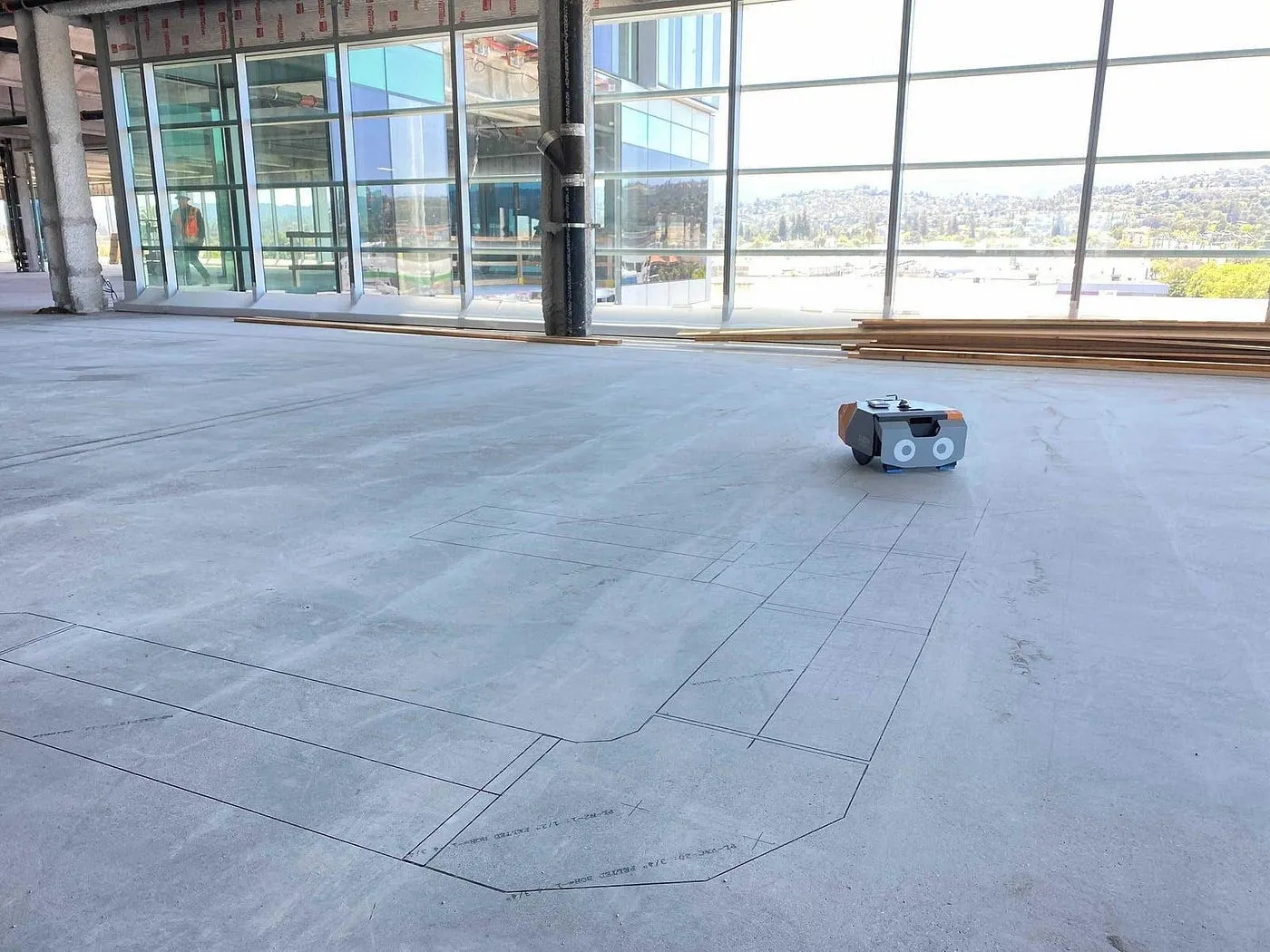
Dusty Robotics' FieldPrinter doing what it does best: printing precise digital floor plans directly onto concrete surfaces, eliminating manual layout errors and compressing one of the most error-prone steps in the construction sequence.
Drone-based reality capture has become increasingly common for tracking site progress, inspecting assets, and certifying outcomes. Companies like DroneDeploy handle the software layer, while hardware developers like Boston Dynamics, Gecko Robotics, and Field AI build the physical platforms.
Automated layout robots print exact digital floor plans directly onto construction surfaces, removing the manual process of transferring designs from blueprint to building. Dusty Robotics makes the best product in the category, with HP (leveraging decades of printing know-how), Rugged Robotics, and CivRobotics among the co-pioneers.
Both categories that have found real adoption share the same trait: they involve little to no physical force. Drones scan. Layout robots print on concrete. Neither one pours it, breaks it, grinds it, polishes it, or drills it. The moment a robot needs to exert meaningful physical action on a material, adoption falls off a cliff.
Why Physical-Task Robots Are Struggling
After meeting dozens of construction robotics companies and their customers, the headwinds break down into three compounding problems.
Picking the Right Workflow: The Framework
Not every construction task is worth automating. And even among those that are, the choice of workflow determines everything about how the business scales, sells, and survives. Getting this wrong is the single most common failure mode for construction robotics companies.
The framework comes down to two dimensions.
| Dimension | Criteria | Why It Matters |
|---|---|---|
| Buy-Readiness | Already purchased as a service with established processes | Customers already have a budget line and a buying habit. You don't need to educate them on why to buy this work. |
| Buy-Readiness | Clear, dedicated budget line (not nested in other costs) | If the cost is buried inside a larger line item, procurement can't evaluate your value proposition cleanly. |
| Buy-Readiness | No questions about norms, standards, or durability | If your approach raises regulatory or code concerns, adoption slows to a crawl regardless of the technology. |
| Success-Readiness | Needs to work functionally, not deliver flawless aesthetics | Robots are better at precision than beauty. Workflows where functional performance matters more than visual perfection are easier to automate. |
| Success-Readiness | High ratio of homogeneous surface to edges and corners | Robots handle large, flat, consistent surfaces well. Edges, corners, and transitions still need human hands. |
| Success-Readiness | Repetitive sequence of functions | Automation thrives on repetition. Variable task sequences push complexity and cost up sharply. |
A few additional spikes matter for early-stage investors looking for outsized outcomes. Narrow, well-defined workflows are easier to build a track record in. Overlooked and labor-intensive tasks, the ones nobody is fighting over, are the best starting points. And the workflow needs a clear P&L line item in the customer's books. Drilling holes or hammering nails don't have dedicated budget lines. Installing curtain walls (like Raise Robotics does) or replacing roof shingles (like Renovate Robotics) do.
Don't sell bricklaying robots. Just lay bricks with robots. Construction is starving for services, not products. The companies that grasp that distinction will win.Bricks & Bytes Editorial
Matching the Business Model to the Workflow
Once you've chosen the right trade to automate, the market dynamics around that trade dictate how you should sell. There's no universal approach. The model has to fit the customer's existing purchasing behavior.
The Thesis, Condensed
- Tools follow an ancient pattern: humanity converts recurring labor costs into one-off capital investments. Robots are the latest chapter, not a departure from the trend.
- Construction is theoretically perfect for robotics due to safety risks, throughput constraints, and quality control demands, but real-world adoption for physical-task robots remains near zero.
- The headwinds are structural: high workflow variance, long sales cycles, slow manufacturing velocity, and companies that try to change customer behavior instead of integrating into it.
- Workflow selection is everything: the best targets are "buy-ready" (already purchased as services with clear budgets) and "success-ready" (functional over aesthetic, repetitive, high surface-to-edge ratios).
- Business model follows market dynamics: sell for equipment replacement, lease for labor replacement or financial relief, deliver outcomes as a service for hidden or fragmented workflows.
- Outcome-as-a-Service remains the wild card: becoming a subcontractor with robots in the backend eliminates sales friction, accelerates track record, and lets you ship imperfect technology while still delivering results.
This thesis is a living thing. Every conversation with a founder, every site visit, every customer interview has the potential to reshape it. Sometimes at the margins. Sometimes fundamentally. That's what makes this space worth watching so closely.
For more on robotics in the built world, explore the Bricks & Bytes podcast and our startup coverage.
Stay ahead of the built world
Join 2,000+ founders, operators, and investors getting the sharpest takes on AEC tech. No fluff. Ever.
Subscribe to the Newsletter




