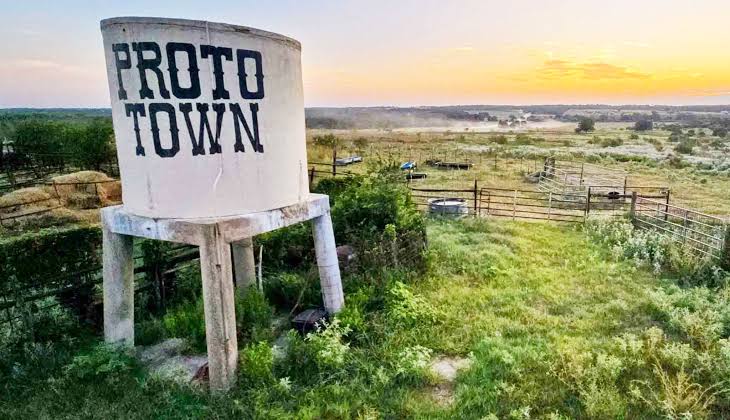
Owen spent a day at Proto-Town, a 1,200-acre ranch near Lockhart, Texas where hardware startups test things that do not fit anywhere else. Autonomous excavators, a nuclear research reactor in the planning documents, and a resident who asked for an airstrip and got one. Martin’s question on the round table was the one worth answering: why is there no European equivalent? Patric’s answer came down to two things Europe struggles to supply. Space, and a single municipality willing to say yes.
Owen had been off the show for a few weeks and came back with the story. He flew to Austin, drove about forty-five minutes south to Lockhart, a town he describes as the barbecue capital of the US, and turned up early one morning at a gate in the middle of Texas ranch land.
A security guard came out and asked whether he had a code. He had a code. The gate opened onto 1,200 acres of deep tech companies testing equipment that has nowhere else to go.
He was there to film with Bedrock Robotics for a Bricks & Bytes documentary, which is where the autonomous excavators come in. What he was not expecting was everything else on the site. His summary of the operating philosophy, offered with the caveat that he does not know it for a fact, was that the only real rule is do not die.
What is actually on the site
Excavators without operators, a house with a swimming pool, and a private airstrip
Bedrock Robotics was the reason for the trip. The company, founded by a team of Waymo veterans including CTO Kevin Peterson, does not build new machines. It takes excavators a contractor already owns and fits them with sensors and a computer, which is closer to installing a very good operator into the machine you already have. We wrote up the visit in Your Data Centre Client Is Changing, and What We Saw in a Place Called Proto-Town.
Bedrock is not alone out there. Owen mentioned another robotics firm holding a plot, having worked with them last year, and a company that had built an actual house out of the land the site sits on. Nuclear and energy projects are in the mix too. Public filings show Earthship Corporation, the developer behind Proto-Town, registered preliminary plans with Texas regulators for a 7,600 square foot nuclear research reactor at an estimated $23 million. Bloomberg reported seeing Oklo constructing a nuclear test reactor on a visit in April.
Then there is the airstrip. One of the plot holders asked for one, got one, and flies daily, trailing a colored stream behind the plane. The founder has a house on site with a swimming pool and a gym, where Owen recorded some of his interviews. Bloomberg’s account adds an 11,000 square foot inflatable office at the center of the ranch and, as the first decorations installed, three billboards showing Oppenheimer at Los Alamos, Theodore Roosevelt, and the Wright Brothers.
It is a tech heaven for people. I was extremely overwhelmed by this haven of a place.Owen Drury, on visiting Proto-Town
The part that makes it work is not the land
Somebody knew who to call
Owen offered one detail that explains more about Proto-Town than the acreage does. One of the co-founders is connected in Texas politics, and the story he was told is that when they decided the site needed three-phase power across the whole thing, a phone call got made and it was in more or less the next day. He was upfront that this is anecdotal. His read was that you need to know the right people to make this happen.
The public record supports the shape of it without confirming the power anecdote specifically. Proto-Town was founded by Merle Nye and Joshua Farahzad, who met at Duke, and former Texas state representative John Cyrier helped them acquire the ranch land south of Lockhart. Cyrier is listed as owner of the entity that holds the land. Caldwell County commissioners approved a development agreement for a 538-acre innovation campus, with county documents describing demonstration of civil construction technologies, advanced manufacturing prototypes in robotics, space and energy research facilities, and temporary living quarters for researchers. That is a remarkably permissive set of words for a planning document.
Martin’s question, and the honest answer
Where is the space, and who says yes
Martin asked it directly. Why is there no Proto-Town in Europe? Patric said there is probably a list of reasons but started with two.
Where is the space. And where is the single entrepreneurial municipality that will simply say yes and change its building code to allow it. His own guess was that Central and Eastern Europe is more likely than Western Europe, or somewhere like Sweden, though he immediately noted Sweden comes with a strong forest protection instinct.
Martin’s frustration was broader and blunter. His view is that after decades the European Union still cannot produce a single set of regulations that lets people do things simply across borders. Dustin raised a related claim he had read, that a large share of European startups now register as Delaware C corps. We have not been able to verify that specific figure and Patric did not confirm it on the show, so treat it as an open question rather than a statistic. The underlying direction is well documented, and the Delaware flip is a standard enough move that an entire advisory industry has grown around it.
Where construction, robotics, and capital actually meet
Weekly intelligence for the people building the industry rather than commentating on it.
Join 3000+ ReadersWhy this matters if you never go to Texas
Testing ground access is becoming a competitive input for construction robotics
Here is the practical reading for anyone building or buying construction technology. Hardware needs somewhere to fail repeatedly, at scale, without a permit cycle attached to every iteration. Software companies got Y Combinator. Hardware companies have historically got a car park and a lot of paperwork.
The pace of construction robotics is now partly a function of where you can run the machines. Bedrock has raised more than $350 million, with a Series B in February 2026, and its proving ground is a Texas ranch rather than a live job site. SoftBank is reportedly assembling a construction robotics entity around ABB Robotics with an eye on a very large listing, which we covered in SoftBank’s $100B Robotics Bet. Capital is not the constraint in this category any more. Iteration speed is, and iteration speed is downstream of somewhere to iterate.
For European contractors and founders, the question is not whether to be jealous of a ranch in Texas. It is whether your region has anywhere a robotics company can spend two years breaking things, and if not, what that means for where the technology you will eventually buy gets developed and who owns it.
| Ingredient | Proto-Town, Texas | Typical European equivalent |
|---|---|---|
| Contiguous land | 1,200-acre ranch, roughly 40 miles from a major tech hub | Fragmented parcels, higher density, competing land use claims |
| Permitting authority | Single county, one development agreement covering many activities | Multiple layers of municipal, national, and EU-level approval |
| Permitted activities | Civil construction demos, robotics, space, energy research, temporary housing | Usually requires separate consent per activity class |
| Utility connection | Reported as fast, with local political relationships cited | Grid queues measured in years across most major markets |
| Nuclear research on site | Preliminary reactor plans filed with the state | Effectively unavailable outside established national facilities |
| Capital access | US venture market, plus a well-worn incorporation route | Smaller domestic venture pools, frequent restructuring into US entities |
It is a privately developed testing ground and hardware startup campus on ranch land near Lockhart, Texas, about 40 miles south of Austin. It was founded by Merle Nye and Joshua Farahzad through their company Earthship, with backing from former Texas state representative John Cyrier, who helped acquire the land. Caldwell County commissioners approved a development agreement covering 538 acres, and Bloomberg has described the working ranch as 1,200 acres, with Proto-Town owning roughly 100 acres and leasing the remainder. The concept is often compared to Y Combinator, but for companies building physical products. (Source)
Plans have been filed, which is not the same as a reactor being operational. Earthship Corporation registered preliminary plans with the Texas Department of Licensing and Regulation for a 7,600 square foot nuclear research reactor at 2600 Mineral Springs Road, with an estimated construction cost of about $23 million. The filing is an early administrative registration and state and federal approvals would be required. Separately, Bloomberg reported observing Oklo constructing a nuclear test reactor on the site during an April visit, intended to generate isotopes for research, energy, and medical uses. (Source)
Bedrock uses Proto-Town as its proving ground for autonomous excavation. The company was founded by a team including former Waymo engineers, with Kevin Peterson as CTO, and its approach is retrofit rather than replacement: sensors and compute fitted to excavators a contractor already owns. Owen tested the safety system on camera by walking toward a working excavator until it stopped, which it did instantly. The company has raised more than $350 million, including a Series B in February 2026. A Bricks & Bytes documentary filmed on site is due for release. (Source)
His two starting reasons were land and governance. Finding contiguous space of this scale near a functioning tech ecosystem is harder in Europe, and finding one entrepreneurial municipality willing to say yes and rewrite its building code to allow the activities is harder still. He suggested Central and Eastern Europe as more plausible than Western Europe, or possibly Sweden, while noting Sweden’s environmental protections cut the other way. Martin’s broader criticism was of the EU’s inability to produce a single simple cross-border regulatory framework. These are views expressed on the show rather than a published analysis.
Dustin raised a figure of roughly 50 to 60% on the show, citing an article he had read, and asked Patric to confirm it. Patric did not confirm it and the conversation moved on. Bricks & Bytes has not been able to verify that specific proportion, so we would not present it as a fact. What is well established is that the Delaware flip is a common route for European founders raising US venture capital, driven by investor familiarity and tax treatment, and that a substantial advisory market exists around it. Some practitioners now argue the necessity of flipping at seed stage is overstated in 2026. (Source)
Local reporting suggests it does, at least so far. Positions created at the campus range from engineering and technical roles through skilled trades and support services, and the project has built links with local schools and training programs, including a Lockhart High School practicum partnership. One resident company, Atmos Thermal, has a Lockhart High School senior on the team through a career and technical education program. Whether that scales alongside the campus, and how the community responds to a research reactor as a neighbor, are open questions worth watching. (Source)
Related Articles
Your Data Centre Client Is Changing, and What We Saw in a Place Called Proto-Town
SoftBank’s $100B Robotics Bet: Why Roze AI Wants to Build the Data Centers AI Runs On
Big Tech Promised $650 Billion in Data Centers. Most of It Isn’t Being Built
Bloomberg: Texas Startup Ranch Proto-Town
The Real Deal: reactor plans filed at Proto-Town
The Real Deal: Caldwell County approves the development agreement
Post Register: Caldwell County and the Proto-Town expansion
ENR: Bedrock Robotics moves earth with autonomous excavators