
Most robotics companies in construction are trying to sell a product. A machine. A unit. Something a contractor buys, figures out, maintains, and integrates into their own operations. And most of them are struggling, because that's not what contractors actually want.
Contractors want outcomes. They want a wall built, a floor ground, a layout printed. They don't care whether a human does it, a robot does it, or a well-trained dog does it. They care that the work gets done on time, on spec, and without a callback.
That distinction, selling outcomes instead of equipment, is the foundation of what we're calling Outcome-as-a-Service (OaaS) robotics. And it might be the most compelling business model in the built world right now.
The Archetype: What OaaS Actually Looks Like
From the outside, an OaaS robotics company looks a lot like a traditional trade contractor. They show up on site. They have crews. They perform work end-to-end and take responsibility for the result. If you squinted, you might mistake them for any other sub on the job.
The difference is in the backend. These companies build, buy, or modify robots that are tuned specifically for deployability and labor productivity. The machine isn't the product. The machine is the engine inside a service that looks, to the customer, exactly like hiring a trade contractor, except faster, more transparent, and more reliable.
You're not building equipment. You're building capacity. The customer is trusting you with an outcome, not buying a tool they have to figure out themselves. That reframing changes everything about how the business scales, sells, and defends its position.
Each crew is a blend of humans and machines. The humans operate the robots, handle the edge cases, deal with the messy real-world conditions that machines still can't navigate alone. The strategic goal over time is reducing the human-to-machine ratio within each crew, not eliminating the humans entirely, but gradually increasing what each person can deliver per hour.
And crucially, if the robot goes down, the crew finishes the job. That's the difference between a robotics demo and a robotics business. The work always gets done.
Why Customers Don't Want Your Robot
Here's something that robotics founders struggle with: contractors are deeply conservative buyers. They've been burned by technology promises before. They don't want to be beta testers for someone's hardware. They don't want to hire operators for a machine they don't understand. And they definitely don't want to explain to their GC why the robot broke down and the schedule slipped.
OaaS removes all of that friction. The contractor doesn't buy anything. They don't learn anything. They don't maintain anything. They issue a purchase order for a scope of work, exactly like they would with any other sub. The robotics company handles everything behind that.
The Customer Experience Advantage
This is where OaaS companies can genuinely embarrass the competition, because the bar in construction services is on the floor.
What does a typical customer experience with a trade subcontractor look like? A phone call. Maybe a text. A vague timeline. Zero visibility into progress. Daily calls filled with excuses and blame-shifting between trades. And when something goes wrong, good luck tracing accountability.
An OaaS robotics company can destroy that on day one. The robot is collecting data as it works. Progress can be piped to a simple dashboard showing exactly what's been done, how fast it's happening, and what's left. You can show absolute metrics (bricks laid, square feet ground, fasteners installed) alongside rate metrics (units per hour, area per shift). A customer who's used to getting a vague phone call at 4pm suddenly has a live feed of verified progress. That alone is worth a premium.
Before work starts: mission planning gives data-driven timelines, estimation is augmented by the equipment's actual production rates. During work: real-time progress tracking with daily automated reports. After work: complete QA/QC audit trail, with logs of every fastener torque, every sealant bead, every layout line. Try getting that from a traditional sub.
And it goes further than just visibility. When you're installing building envelopes, thousands of fasteners need correct torque and hundreds of meters of edges need proper caulking. If any of it is wrong, rework can cost ten times the original install. Do that work with robots, and you've got near-perfect logs of every fastener, every visual inspection, every sealant application. The liability reduction alone justifies the approach.
Tessa Lau, founder of Dusty Robotics, made a point worth repeating here: the value isn't just doing the same work faster. It's doing work that humans physically can't match. Dusty doesn't just snap chalk lines quicker. It prints words and symbols onto concrete with precision that manual methods can't replicate. Customers pay more than the labor cost because they're getting a capability that didn't exist before. That's what accelerates adoption.
The Margin Structure That Makes Investors Pay Attention
The financial architecture of OaaS robotics is genuinely different from both traditional contracting and traditional robotics.
| Dimension | Traditional Contractor | OaaS Robotics Company |
|---|---|---|
| Pricing | Competing on lowest bid. Margins squeezed constantly. | Prices at or slightly below top-tier bids, with premiums for QA/QC, speed, and data. |
| Cost Structure | Labor-heavy. All OpEx. Margins erode with scale. | Shifts OpEx toward CapEx. Labor efficiency improves with fleet growth. |
| Speed | Capped by crew size and human output. | Machines increase throughput per crew. Volume scales with fleet. |
| Capacity | Limited by available labor. Backlog grows, can't deliver. | Robot fleet expands capacity. Can absorb overflow from strained competitors. |
| Capital Access | Traditional bank debt, if available. Limited options. | Venture capital, private credit, asset-backed financing. Entirely different toolkit. |
| Talent | Struggling to recruit. Aging workforce. Low appeal to young workers. | Attracts younger talent. Working alongside robots is, counterintuitively, pretty appealing. |
The result is structurally higher gross margins. You're faster, so you've got lower operating expenses per unit of work. You're converting variable labor costs into fixed capital costs, which makes the P&L more predictable. And you can take on more volume because your capacity isn't capped by how many humans you can hire in a tight labor market.
When margins are healthy, business development options multiply. Plenty of large contractors are sitting on contracts they won but can't fully execute because they've lost labor capacity since they bid the work. An OaaS company can slot in as a sub-of-a-sub and absorb that overflow. It's not glamorous work, but it's profitable and steady.
The question investors should be asking isn't "how do you grow faster than a contractor?" It's "how do you build the best customer experience in the market on top of fundamentals no competitor can match?"Bricks & Bytes Editorial
The Real-World Proof
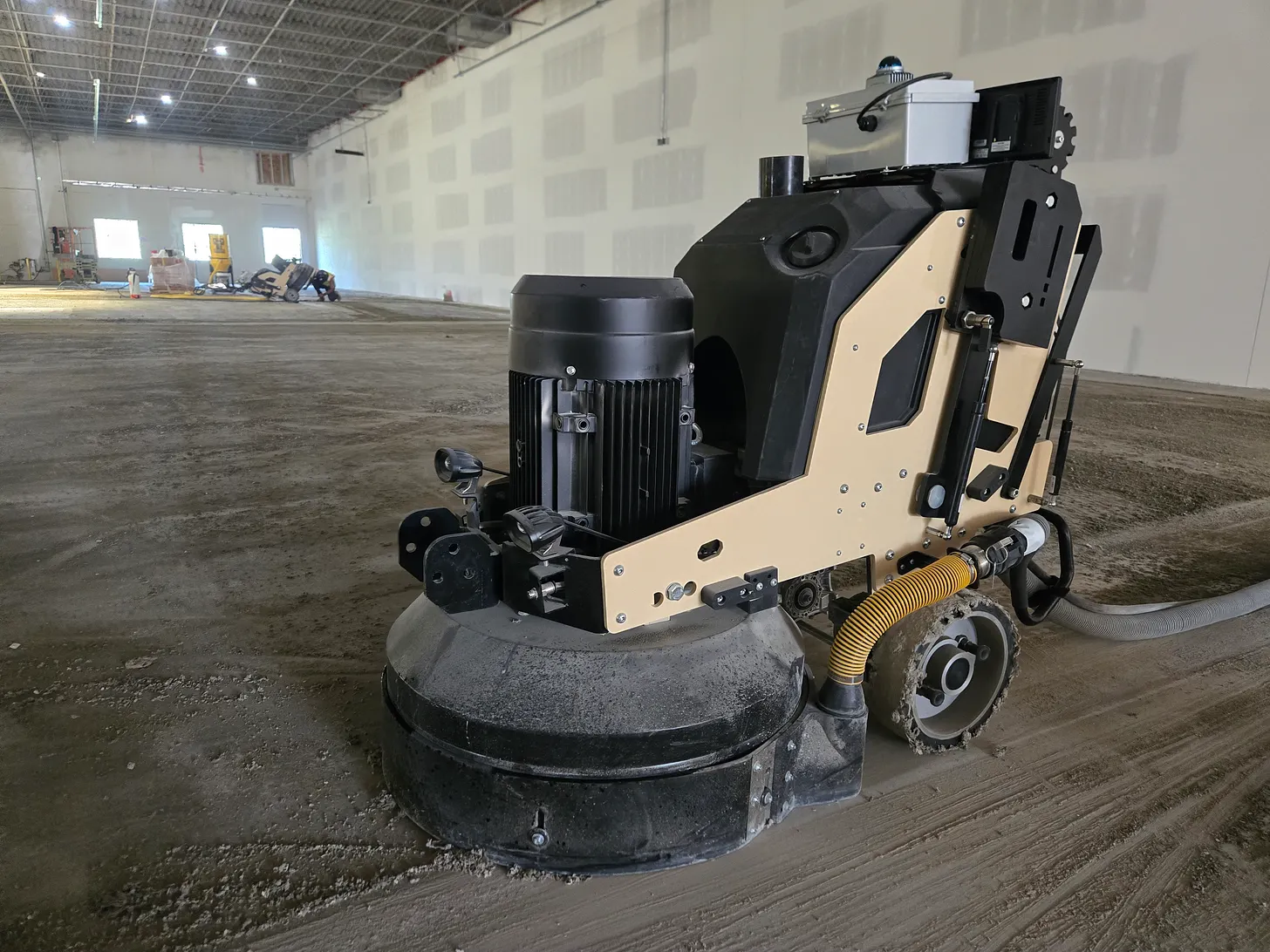
Robots doing real work in the real world: Tempo Works' concrete grinding robots operating autonomously in a large warehouse facility. TW's founder, Kevin, has been an incredible partner for pressure-testing and refining the OaaS robotics thesis.
This isn't a rendering. It's not a demo reel from a trade show. That's actual production work being done by robots on a live job site. The distinction matters because half the robotics companies in construction have slick videos and zero revenue. Tempo Works has revenue, repeat customers, and a model that scales.
Scaling: The Hard Part Nobody Talks About
If the OaaS model is so compelling, why isn't everyone doing it? Because scaling physical operations while simultaneously building robotics technology is genuinely brutal. You're managing two enormously complex things at once: R&D and manufacturing on one side, service delivery and geographic expansion on the other.
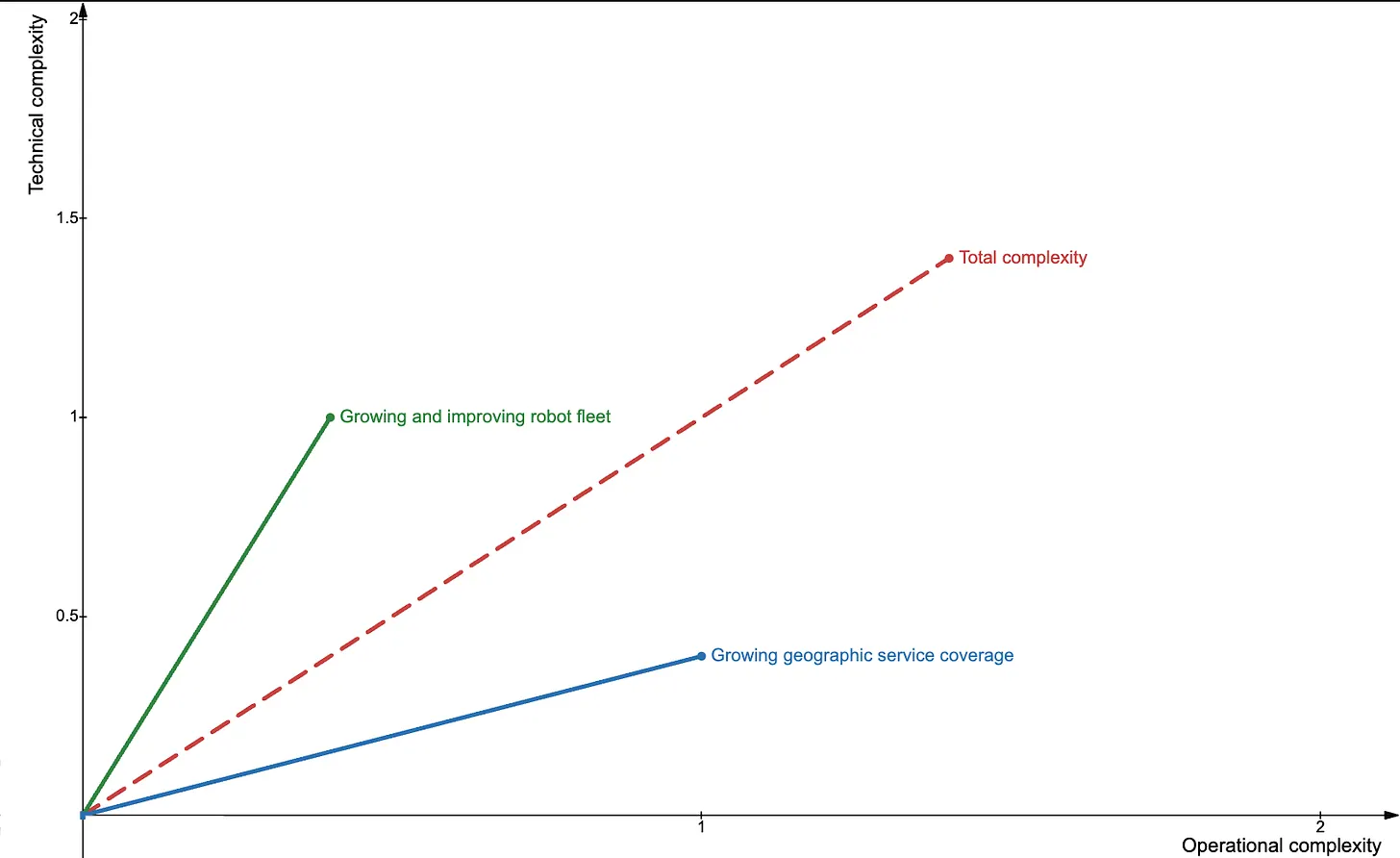
The mental model for scaling OaaS robotics. The horizontal axis captures the operational complexity of spinning up new locations. The vertical axis captures the R&D and manufacturing overhead. Both vectors compound simultaneously.
Each new location has a minimum viable cost: a lease, a truck, basic tooling (robots are never the full picture), insurance, backoffice overhead, and a plan to manage working capital. Cash flow management is everything here, and factoring services become critical infrastructure for these businesses.
The complexity also depends heavily on what workflow you're automating. Consider the difference between lawn care and demolition.
The Growth Playbook
Scaling faster than a traditional contractor is the question every investor leads with. The honest answer is that there's no shortcut, but there is a specific playbook that works.
Higher target margins don't exempt you from choosing where to operate wisely. Access to an active market is critical when you're delivering physical outcomes, hiring local labor, and deploying equipment. The best technology in the wrong geography is still a losing proposition.
The Talent Angle Nobody Expected
There's a counterintuitive dynamic playing out with recruitment. The construction industry is hemorrhaging workers. Young people don't want to enter the trades. The work is physically demanding, the perception is outdated, and the career path feels unclear.
OaaS robotics companies flip that narrative. Working alongside robots, operating advanced equipment, being at the technological edge of a traditional field, that actually attracts younger workers. You're promising to remove the most repetitive, physically punishing tasks and replace them with something more engaging. It's a genuine differentiator in a labor market where every contractor is fighting for the same shrinking pool of talent.
- Physical coverage - you need locations, crews, and local market access. This can't be replicated by a software startup from a coworking space.
- Proprietary technology - the robots, the software, the data pipeline, all tuned through thousands of hours of real deployment.
- Structural cost advantage - OpEx to CapEx conversion, labor efficiency gains, and fleet economics that compound over time.
- Track record flywheel - every delivered outcome builds supplier trust. Customers need simplicity and repeatability, and your history of execution becomes the moat.
- Data moat - every job generates production data that feeds back into better estimation, better mission planning, and better robot performance.
Where This Goes Next
The OaaS model is still early. The companies doing it well can be counted on two hands. But the trajectory is clear, and the tailwinds are enormous: a labor crisis that's only getting worse, capital that's increasingly available for technology-enabled services, and a customer base that is desperate for reliability.
The open questions are interesting ones. Can system integrators emerge to help contractors adopt robots without building their own? Is there room for tech-first mega-subs that aggregate capacity across markets? And what financial products and structures will unlock the next wave of growth for these companies?
We'll be watching this space closely. For more on robotics in the built world, check out our BitBuilders series or browse the latest startup coverage.
Stay ahead of the built world
Join 2,500+ founders, operators, and investors getting the sharpest takes on AEC tech. No fluff. Ever.
Subscribe to the Newsletter




